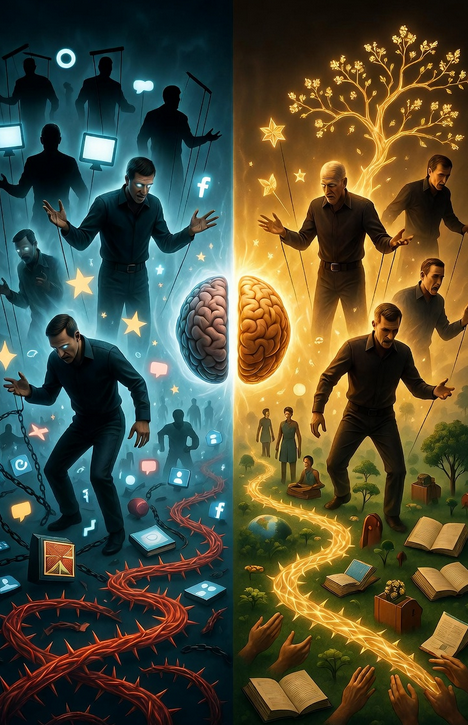
Hosts Michael and Jason kick off the show over coffee with a conversation that wanders from stray cats and homelessness to Epicurean philosophy, augmented reality, ADHD, and the future of AI. A casual but surprisingly deep exchange about compassion, cognition, and how to stay afloat when certainties are low.
Up the Squelch — Episode 0001 Synopsis
Hosts: Michael and Jason
Overview
A wide-ranging, free-form conversation between two friends exploring ideas at the intersection of philosophy, technology, mental health, and everyday human experience. The episode opens with coffee, cats, and compassion, then spirals outward through homelessness, cognition, AI and the nature of survival itself.
Topics Covered
Cats & Compassion
Michael cares for a colony of indoor and outdoor cats, including an elderly stray named Fuzzy. The discussion uses this as a launching point for the ethics of helping others: you can't save everybody, but narrowing your scope and doing
something is better than paralysis. The cats become a metaphor for survival anxiety and empathy.
Homelessness & Social Trust
Michael shares personal experience with houselessness — first in California, then Chicago — describing how it "creeps up on you." A key observation: sometimes strangers and social services offer more reliable help than longtime friends, who draw healthy but limiting boundaries.
Cognitive Tools & Augmented Reality
The hosts explore how tools (transcription software, grabbers, closed captions) function as extensions of human ability rather than replacements. Michael, who identifies as hypervigilant and on the spectrum with ADHD tendencies, frames augmented reality as a potential equalizer — giving people with attention and sensory processing differences the ability to function more fully in social situations.
Sensory Perception & Consciousness
A detour into phosphenes, scrying, and the idea that suppressing one sense can amplify others. Leads into a discussion of the "Akashic records" and the nature of present-moment consciousness.
Epicurean Philosophy & Drugs
Michael references Epicurus — pleasure through simplicity and quality, not gluttony. Jason connects this to a book idea:
How to Do AI [Or Drugs] Like a Professional — distinguishing purposeful use from compulsive behavior. The "uh-oh" test: are you doing the thing for a reason, or just doing the thing?
AI & Faculty Resource Displacement
The episode closes on AI and automation. Jason coins the concept of "faculty resource displacement" — when AI handles repetitive tasks, human mental faculties don't disappear, they get redirected (like buoyancy or the second law of thermodynamics.) Both hosts express cautious optimism: if AI takes over drudge work, humanity might finally have time to think. Fear-based opposition (the "Terminator reflex") is seen as more likely to produce bad outcomes than thoughtful engagement.
Themes
- Scope reduction as a coping strategy
- Cooperation and interconnectedness as survival tools
- Tools vs. crutches: the difference is whether they extend or replace
- "Surfing reality" — maintaining a positive through-line without denial
- The wiring of neurodivergent minds as a different baseline, not a deficit